
TRAKVON · 2026 BUYER RESOURCES
Remote-Controlled Slope Mowers vs Tractor-Mounted Boom Mowers for Ditch Banks and Roadside Verges (2026)
Choose a tractor-mounted boom mower when a firm shoulder gives the tractor a stable working position and the cutting head can reach the bank. Choose an operator-directed remote-controlled mower when the machine can access the bank but boom reach, obstacles or riding-machine access leave grass uncut. For open, accessible verges, compare the existing tractor-based operation first; for constrained banks, compare remote-machine access and the full completed visit.
By Shandong Juxing Heavy Industry Machinery Co., Ltd. · Last updated:
Key takeaways: when each machine makes sense
- Choose a boom mower for reachable banks beside a firm shoulder. The tractor can remain on the supporting surface while the arm positions the head on the bank.
- Choose a remote-controlled mower for accessible ground beyond boom reach. It brings the cutter onto the bank instead of extending an arm from the road.
- Shortlist remote control for narrow strips between barriers and obstacles. Compare the whole machine with the gaps around guardrails, fences, trees, drains and signposts.
- Keep tractor-based mowing in the comparison for broad, open verges. Wider effective passes and existing transport arrangements can favor the conventional operation.
- Use both machines when the corridor contains different tasks. Allocate reachable verge sections to the tractor and assess a remote machine for the remaining bank sections.
- Compare slope figures with their evidence. Caltrans reported no known common standard for determining or comparing remote-mower slope ratings in its 2019 study.
Caltrans 2019, Table 2.1 footnote; the equipment choices above are a worksite-selection framework.
How each machine works
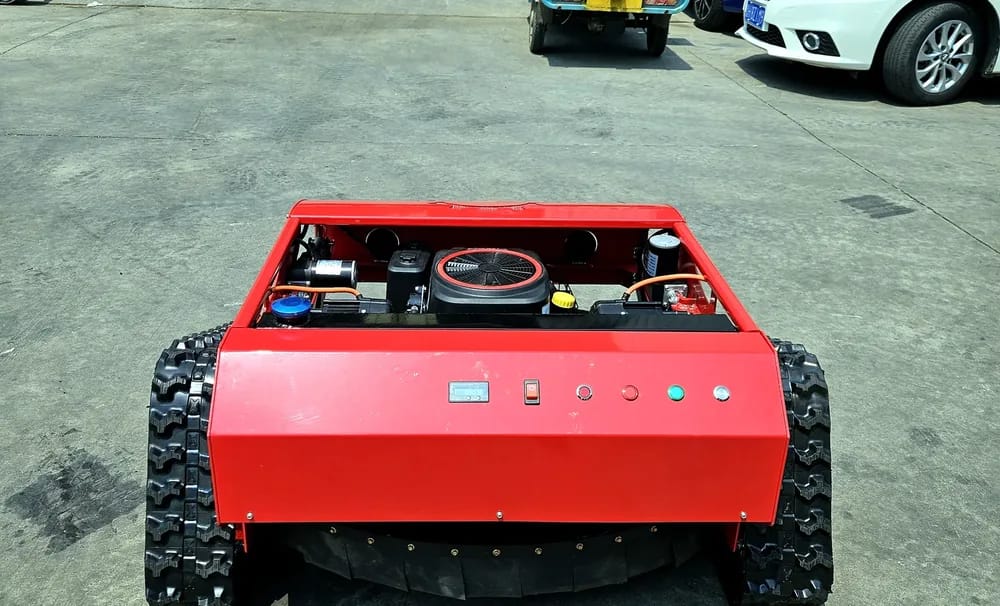
A tractor-mounted boom carries the cutting head on an articulated arm; the tractor may stay on an approved shoulder while the head reaches the bank. An operator-directed remote mower travels over the cutting area while the operator remains at an assessed control position. The appropriate operator position depends on visibility, traffic, thrown objects and the machine instructions; standing on the shoulder is not automatically safe.
Access: road shoulder width, guardrails, culverts and narrow drainage ditches
Use boom reach when the tractor has a good working position; use remote-machine access when the cutter needs to travel through the working strip. This comparison separates those two routes to the vegetation.
| Worksite condition | When to choose a tractor-mounted boom mower | When to choose a remote-controlled mower |
|---|---|---|
| Firm shoulder; bank within arm reach | Start with a boom mower: reach the bank while keeping the tractor on the supporting surface. | Consider remote control if the bank has connected access and a useful continuous mowing route. |
| Bank beyond arm reach; an access route exists | Requires a different tractor position or a longer compatible reach. | Start with a remote mower: carry the cutter to the work rather than reaching from the road. |
| Narrow strip between guardrail and fence | Useful only where the arm and head can clear the barriers. | Shortlist remote control when the whole machine and turning envelope fit the strip. |
| Trees, signposts, drain openings or culvert approaches | Compare head positioning and the amount of separate finishing. | Compare maneuvering room and visibility; machine width matters more than cutting width at a pinch point. |
| Water or unsupported ground blocks machine access | Consider a boom only from an approved, supported tractor position within reach. | Use a different method if there is no supported entry, working route and recovery route. |
| Long, open verge with few interruptions | Start with the existing tractor-based workflow and its effective cutting width. | Compare only after including loading, travel, setup and any extra finishing. |
Prepare the five-question site brief before requesting a machine shortlist.
Slope and ground conditions: compare working limits
Caltrans’s 2019 field report described about 3:1 (18°) as a typical tractor-based mower limit and about 2:1 (27°) for the observed AEBI riding slope mower on dry California grass. It identified two banks approaching 1:1 (45°) as remote-mower candidates, but did not demonstrate mowing there. These are study-specific observations and recommendations, not universal operating limits. Read report pp. 27–30.
For a boom mower, distinguish the slope carrying the tractor from the bank reached by the arm. For remote equipment, compare the permitted travel direction and actual ground support. Caltrans also noted the lack of a known common slope-rating standard in the study; its steepest practical remote-mower limit remained unresolved.
The catalog lists TRAKVON four-wheel-drive 196 at 30°, TRAKVON 195-80YC at 45°, TRAKVON 608-90A at 70°, and TRAKVON 764-90A and TRAKVON 810-130A at 60°. The current TRAKVON 452-80L parameter sheet lists a 60° catalog working slope; confirm the quoted build and the conditions behind the figure before selection. These working-slope figures are comparison inputs, not site safety approval. The supplied sources do not specify test direction, surface, moisture or load; request the applicable operating instructions.
Safety exposure: operator position, rollover, debris and traffic
Remote operation removes the rider from the mowing machine. The operator still needs a clear view and a position outside the machine’s path, thrown-object area and traffic exposure. Plan the road work zone and exclusion area before selecting an operating position.
OSHA’s riding-mower guidance advises avoiding slopes above 15° when manufacturer angle information is unavailable. It also says to keep drive wheels at least 5 ft, measured from the outside wheel edge, from unprotected drop-off hazards such as ditches and embankments. These instructions concern riding mowers; they are not a remote-mower setback or a TRAKVON slope rating.
Cutting width and productivity per visit
Compare effective cutting width after overlap, obstacles, repositioning and finishing. A boom may reach vegetation without moving a carrier onto the bank; a remote machine may make connected passes where access supports them. Neither arrangement guarantees a faster visit. Record area completed to an agreed finish, total crew hours, traffic setup, transport, stops, cleanup and return travel.
The 2019 Caltrans remote-control mower evaluation found useful roles on slopes and in confined areas, while conventional mowing was more cost-effective for most of its roadside mowing. The study evaluated other machines, not TRAKVON, and does not supply TRAKVON productivity figures.
Cost structure, not price
| Cost item | Tractor-mounted boom mower | Remote-controlled mower |
|---|---|---|
| Equipment | Tractor, compatible boom / head, transport provision | Mower, loading equipment and suitable transport |
| Labor | Competent tractor / boom operator and site crew as required | Trained remote operator and site crew as required |
| Service | Tractor, hydraulics, arm and cutting-head maintenance | Engine, cutter, drive and controller maintenance |
| Site overhead | Traffic arrangements, positioning and finishing | Traffic arrangements, access, recovery and finishing |
Licensing, transport and crew requirements depend on the destination and task. Do not assume one operator is sufficient for every roadside job.
Confirm parts and service before comparing ownership costs.Mixed fleets: when a boom mower and remote-controlled mower work together
Divide a corridor into accessible verge, reach-only bank and machine-accessible bank sections. Assign each section after reviewing reach, ground, traffic, vegetation and recovery. Keep finishing and traffic work in the job estimate; a second machine is useful only when the combined workflow improves the actual visit.
Which TRAKVON models should enter a ditch-bank assessment?
Use these dimensions to prepare a shortlist; they do not approve the machine for the bank. Each row contains catalog figures requiring site-specific confirmation.
| Model | Cutting width | Machine size L×W×H | Packed size L×W×H | Listed weight | Engine / fuel / power | Chassis | Catalog slope figure | Cutting-height adjustment | Travel speed |
|---|---|---|---|---|---|---|---|---|---|
| TRAKVON 195-80YC | 800 mm | 1630 × 950 × 700 mm | 1740 × 920 × 1070 mm | 372 kg; bare-machine or packed basis not specified | Koop diesel · 18 HP | Rubber tracks | 45° | 30–200 mm | 0–5 km/h |
| TRAKVON 452-80L | 800 mm | 1070 × 1170 × 600 mm | 1150 × 1240 × 750 mm | 240 / 285 kg | LONCIN / Rato gasoline · 16 HP | Rubber tracks | 60° catalog figure | 10–180 mm | 0–5 km/h |
| TRAKVON 608-90A | 900 mm | 1400 × 1300 × 630 mm | 1510 × 1370 × 800 mm | 330 / 390 kg | LONCIN gasoline · 22 HP | Rubber tracks | 70° | 10–200 mm | 0–6 km/h |
| TRAKVON 764-90A | 900 mm | 1400 × 1300 × 630 mm | 1510 × 1370 × 800 mm | 308 / 380 kg | LONCIN gasoline · 27 HP | Rubber tracks | 60° | 10–200 mm | 0–6 km/h |
Catalog figures describe the listed configurations. Match each machine and operating limit to the site. Packing dimensions describe the shipment, not operating clearance; check the loaded configuration with your carrier.
Frequently asked questions
How do remote-controlled mowers compare with boom mowers for ditch maintenance?
Choose a boom mower when the tractor has a firm working position and its head reaches the required bank surface. Choose remote control when a supported machine-access route reaches vegetation beyond the boom or through a constrained strip. Separate the corridor into sections: a mixed workflow can be more useful than expecting one machine to cover every bank.
What is an affordable alternative to a tractor-mounted boom mower for ditch banks?
Cost a compact, operator-directed remote-controlled mower first when the hard-to-reach bank sections have a supported access route. In the TRAKVON range, start the shortlist with the 800 mm models: the tracked 195-80YC (950 mm machine width) and the tracked 452-80L (1170 mm machine width), then confirm the exact build and operating limits for the site. Whether it costs less than a boom mower depends on the completed visit, not the purchase price alone: equipment allocation, crew time, transport, setup, fuel, wear, cleanup and finishing. Retaining an existing tractor for open verge work may be more economical than replacing the whole workflow. TRAKVON confirms price in a written quotation for each order.
What would you recommend for mowing narrow roadside drainage ditches?
Start with the narrowest machine that fits the measured entry gap and bank strip, because overall machine width, not cutting width, decides access. Among TRAKVON documented models, the narrowest is the wheeled four-wheel-drive 196 (830 mm machine width, 550 mm cutting width); the narrowest tracked model is the 195-80YC (950 mm machine width, 800 mm cutting width). Measure the entry gap, usable bank strip, obstacles and turning space, and add the required clearance. A remote-controlled mower is a useful candidate for a connected narrow route; a boom may reach an isolated section without putting a carrier onto the bank. Confirm the exact build and its operating limits for the site before ordering. See the bank and verge selection guide.
Does a higher slope rating mean a better ditch-bank mower?
No. A higher catalog figure does not establish better access, grip or completed-job output. Compare the study evidence and catalog conditions above, then match the manual’s direction and ground limits to your route. On a ditch bank, the transition at the bottom, water edge and recovery route can decide the equipment choice before the headline angle does.
Which mower is more productive: a boom mower or a remote-controlled mower?
The more productive choice completes the specified area and finish with less total visit time. Effective width, overlap, arm repositioning, turns, obstructions, transport and separate trimming all affect that result. Compare a representative full visit rather than multiplying deck width by maximum travel speed. For an open verge start with the tractor workflow; for interrupted banks compare access and finishing time.
Can a remote-controlled mower replace a boom mower everywhere?
No. It is a strong candidate where a machine-accessible bank lies beyond boom reach or contains constrained grass strips. A boom remains useful when its tractor can stay on supported ground and reach vegetation a carrier cannot safely access. Review parts and service alongside the task: confirm the ownership support arrangement for the exact model and destination.
Continue your equipment comparison
About TRAKVON and these sources
TRAKVON is the export brand operated by Shandong Juxing Heavy Industry Machinery Co., Ltd. (山东聚星重工机械有限责任公司), Jining, Shandong, China. This guide supports equipment comparison and export inquiries.
Source documents: TRAKVON 12-page photo catalog and linked model sheets. Model data are configuration-specific; third-party guidance is not testing of TRAKVON equipment.