Usable clearance
Measure the minimum gap between trunks, supports, stakes and irrigation. Include low branches and any narrowing on uneven ground.

ROWS, HEADLANDS AND GROUND COVER
For orchard or vineyard mowing, compare the narrowest clear passage with the mower's overall width and height, then check headland turns, irrigation lines and changes in slope. Cutting width alone is not an access measurement. Distinguish row-middle mowing from work around trunks or beneath trellises before selecting equipment.
By TRAKVON · Updated
Start with the area to be maintained. Row middles may provide a continuous route, while the space around trunks, posts, irrigation fittings and low branches may require a different finish or method. Measure clear width at the tightest points rather than using tree-centre or trellis-centre spacing.
UC IPM's plum orchard guidance distinguishes management within tree rows from vegetation between rows. Virginia Tech's vineyard floor guide similarly separates interrow and under-trellis areas. These agronomic distinctions help define the job before a mower is chosen.
Measure the minimum gap between trunks, supports, stakes and irrigation. Include low branches and any narrowing on uneven ground.
Show row-end space, fences, access roads and the next-row entry. Check the full machine envelope along the turn.
Describe cover crops, grass, pruning debris and the required cut height. Mark young trees, exposed roots, tubing and areas needing separate treatment.
START WITH ACCESS
Send photos along the row, at the narrowest point and across the headland. A simple measured layout makes the equipment inquiry more useful than the crop name alone.
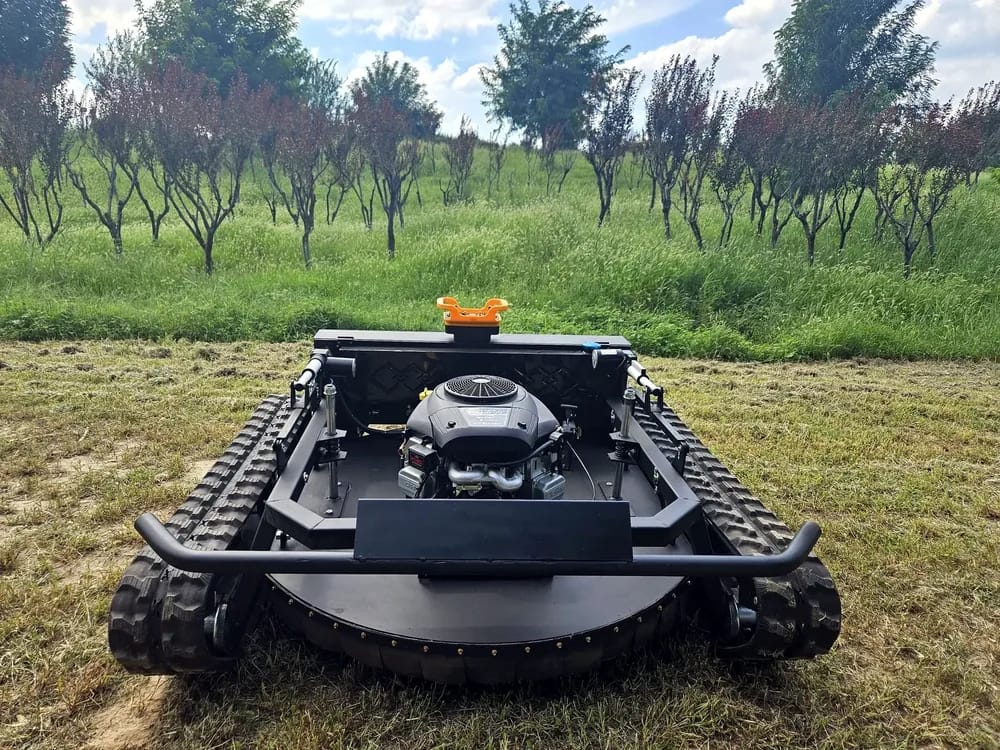
Supplier product photograph in an orchard setting; not a verified customer project.
Compare all catalog modelsThe following catalog configurations provide different body widths and heights. Allow operating clearance beyond the stated dimensions and review the whole route. These figures do not establish an under-tree reach or an offset cutting function.
| Model | Cutting width | Machine L × W × H | Access question |
|---|---|---|---|
| Four-wheel-drive 196 | 550 | 1000 × 830 × 430 | Do the wheel configuration and route suit the ground and desired finish? |
| 195-80YC | 800 | 1630 × 950 × 700 | Does the longer body fit headland turns and low branches? |
| 452-80L | 800 | 1070 × 1170 × 600 | Does the full body clear trunks, posts and irrigation? |
Dimensions come from the linked model pages. An 800 mm cutting width does not mean an 800 mm-wide passage is sufficient: the 195-80YC and 452-80L bodies are wider than their cutting widths. For sloping rows, assess grade, travel direction and surface using the site checklist; compare chassis trade-offs in the tracked and wheeled mower guide.
Agree on the vegetation to retain, the intended finish and the cutting schedule with the grower. Virginia Tech's guide discusses both benefits of cover crops and their competition with vines for water and nutrients; mowing is one part of that wider management choice. Its Mid-Atlantic recommendations are not a universal prescription for other growing regions.
Record surface conditions after irrigation or rain, especially on sloping rows. HSE's vehicle guidance notes that wet ground can change slope suitability. Use the supplied machine instructions and a local assessment when planning the work.
Check the cutting reach and machine envelope against trunks, stakes and tubing. Some areas may need a separate method. No automatic trunk-sensing or offset cutting capability is implied by this page.
No. Soil condition, turning, route choice and the actual chassis matter. Compare the ground and required finish with a model-specific evaluation rather than assuming a universal soil-protection advantage.
Use the overall machine width plus suitable working clearance. The catalog lists the 195-80YC at 950 mm wide and the 452-80L at 1170 mm wide. Turning and obstacles can require more space than straight travel.
Include the crop, ground conditions, vegetation and destination.
Reviewed October 22, 2026: UC IPM, plum integrated weed management; Virginia Tech, Floor Management Strategies for Virginia Vineyards, first published 2020, reviewed 2025; HSE, vehicle slope assessment.
| Model | Machine width | Machine height | Machine length | Machine weight | Catalog working slope |
|---|---|---|---|---|---|
| Four-wheel-drive 196 | 830 mm | 430 mm | 1,000 mm | 100 kg | 30° catalog figure |
| 195-80YC | 950 mm | 700 mm | 1,630 mm | 372 kg listed; machine/packed basis not stated | 45° catalog figure |
| 452-80L | 1,170 mm | 600 mm | 1,070 mm | 240 kg | 60° catalog figure |
| 608-90A | 1,300 mm | 630 mm | 1,400 mm | 330 kg | 70° catalog figure |
| 764-90A | 1,300 mm | 630 mm | 1,400 mm | 308 kg | 60° catalog figure |
| 810-130A | 1,710 mm | 680 mm | 1,430 mm | 470 kg | 60° catalog figure |
Measure the usable row width at the narrowest point and the lowest branch height, then compare machine width and height. Allow headland turning space for the machine length.
Slope figures are supplier catalog comparison values. The source sheet does not state travel direction, ground, moisture or load. Check the quoted build and model-specific operating instructions; no row in this table is a site suitability recommendation.